BMI Calculator: Check Your Body Mass Index and Understand Your Health
BMI Calculator
—
Meaning
—
Next Steps
—
BMI is a general screening tool, not a medical diagnosis.
BMI Calculator (Instant Tool)
Enter Your Details
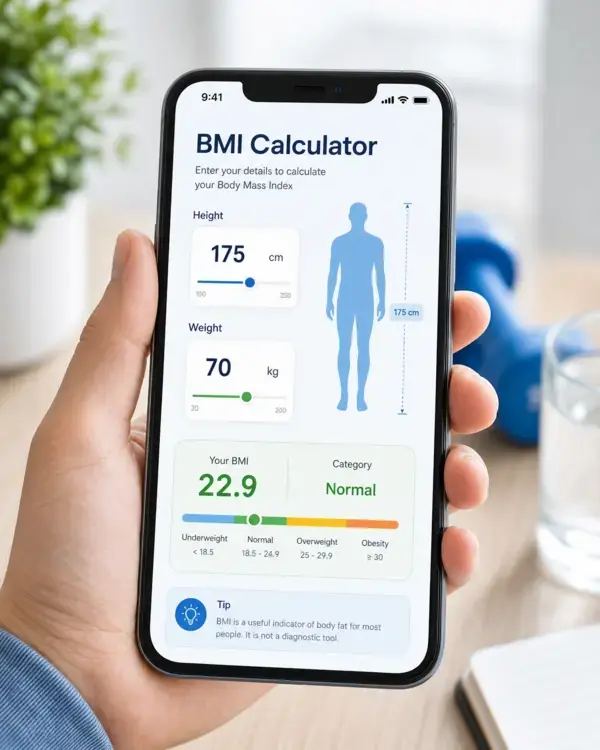
Use this BMI Calculator to check your body mass index in seconds. Enter your height and weight in the fields below.
Make sure your values are accurate for a reliable result. Small input errors can change your BMI score.
Your BMI Result
The BMI Calculator shows your body mass index instantly.
Your result includes:
This classification follows standard BMI ranges used worldwide.
What Your Result Means (Quick Summary)
Your BMI score helps assess your weight status and health risk.
Use this BMI result as a starting point, not a final diagnosis. For deeper insight, combine BMI with body fat and lifestyle data.
What Is BMI (Body Mass Index)?
Definition of BMI
Body Mass Index measures body weight relative to height. The BMI Calculator uses this formula to estimate body fat levels. BMI = weight in kilograms divided by height in meters squared. This result gives a simple health risk indicator. BMI does not measure body fat directly. It provides a quick screening tool for weight classification.
Why BMI Is Used Worldwide
Health professionals use BMI because it is simple and fast. The BMI Calculator requires only height and weight inputs. It helps identify underweight, normal weight, overweight, and obesity. These categories link to common health risk levels. BMI supports population-level health analysis. It helps track obesity trends and weight patterns. Many health systems use BMI for initial screening. It works well for large groups and general assessment.
WHO BMI Classification Standards
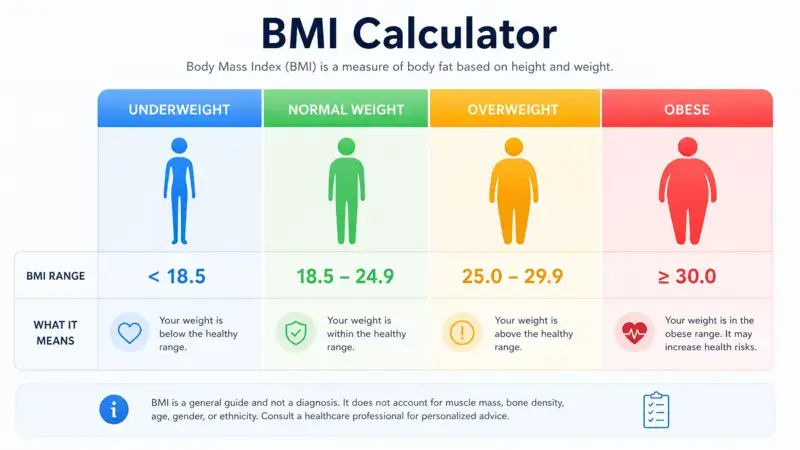
Standard BMI ranges define weight categories clearly. The BMI Calculator uses these ranges to show your category.
Higher BMI levels link to increased health risk. Lower BMI levels may indicate undernutrition or low body fat. These standards provide a consistent global reference.
BMI Chart and Weight Categories
Standard BMI Ranges
The BMI Calculator assigns a weight category based on your BMI score. These ranges help assess your weight status and health risk.
These categories form a standard weight classification system. They support basic health risk assessment using body mass index.
Visual BMI Chart Table
| BMI Range | Weight Category | Health Risk Level |
| Below 18.5 | Underweight | Possible nutritional risk |
| 18.5 – 24.9 | Normal weight | Lower health risk |
| 25 – 29.9 | Overweight | Moderate risk |
| 30 – 34.9 | Obesity Class 1 | High risk |
| 35 – 39.9 | Obesity Class 2 | Very high risk |
| 40 and above | Obesity Class 3 | Severe health risk |
Use this chart with the BMI Calculator for quick evaluation. Combine results with lifestyle and body composition data for better insight.
How to Calculate BMI (Formula Explained)
BMI Formula (Metric)
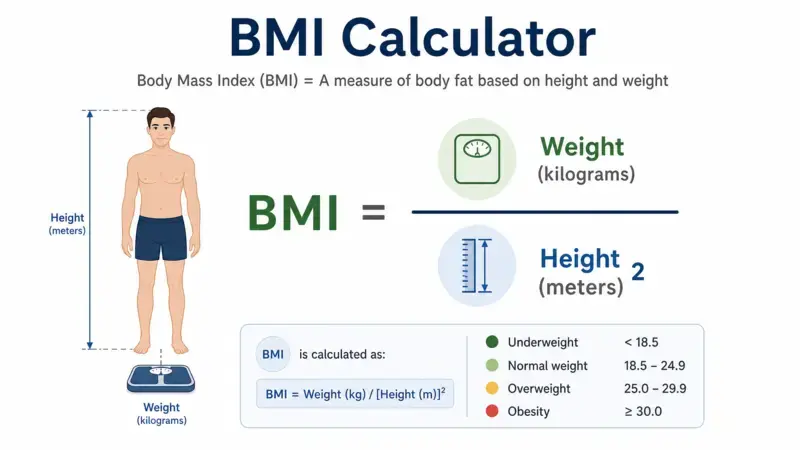
The BMI Calculator uses a simple formula based on metric units. BMI equals weight in kilograms divided by height in meters squared.
Formula: BMI = weight (kg) / height² (m²)
First, convert height from centimeters to meters. Then square the height value. Divide your weight by this squared number. This method gives a quick body mass index score.
BMI Formula (Imperial)
The BMI Calculator also supports imperial units. This method uses pounds and inches.
Formula: BMI = (weight (lbs) / height² (inches)) × 703
First, square your height in inches. Divide your weight in pounds by this number. Multiply the result by 703. This converts the value into a standard BMI score.
Step-by-Step Examples
Example (kg/cm)
Weight: 70 kg
Height: 170 cm
Convert height to meters: 1.70 m , Square height: 1.70 × 1.70 = 2.89
Divide weight by height squared: 70 ÷ 2.89 = 24.22
BMI result: 24.22 This falls within the normal weight range.
Example (lbs/feet)
Weight: 154 lbs
Height: 5 feet 7 inches
Convert height to inches: 67 inches , Square height: 67 × 67 = 4489
Divide weight by height squared: 154 ÷ 4489 = 0.0343
Multiply by 703: 0.0343 × 703 = 24.1
BMI result: 24.1 This indicates a healthy weight category.
What Is a Healthy BMI Range?
Ideal BMI for Adults
A healthy BMI range falls between 18.5 and 24.9. The BMI Calculator uses this range to assess normal weight status. This range links to lower risk of common health conditions. It supports balanced body composition and stable metabolism. Values below 18.5 suggest underweight status. Values above 24.9 indicate excess body weight. Use this range as a general health guideline. Combine it with body fat percentage for better accuracy.
BMI Differences by Age and Gender
BMI does not adjust fully for age or gender differences. The BMI Calculator provides a general estimate for adults. Older adults may carry more body fat at the same BMI. Younger individuals may show different fat distribution patterns. Hormonal changes can affect weight and fat storage. Metabolism rate also changes with age. Use BMI with other health metrics for better insight.
BMI for Men vs Women
Men and women store fat differently in the body. The BMI Calculator does not account for this difference. Men often have higher muscle mass than women. Women usually have higher body fat percentage at the same BMI. A similar BMI score may reflect different body composition. This can affect health risk interpretation. Use waist-to-hip ratio and body fat analysis for clarity.
Limitations of BMI (Important Insight)
BMI Does Not Measure Body Fat
The BMI Calculator estimates weight status, not body fat percentage. It uses height and weight only. BMI cannot show fat distribution in the body. It cannot separate fat mass from lean body mass. Two people can share the same BMI with different body composition. One may have higher fat, while the other has more muscle. Use body composition analysis for deeper health assessment.
Athletes and Muscle Mass Issue
Athletes often have high muscle mass and low body fat. The BMI Calculator may classify them as overweight or obese. Muscle weighs more than fat at the same volume. This can raise BMI without increasing health risk. Strength training increases lean body mass over time. BMI does not adjust for this change. Use body fat percentage and performance metrics for accuracy.
Ethnicity and Body Composition Differences
Body composition varies across different populations. The BMI Calculator uses general global standards. Some groups may carry higher body fat at lower BMI values. Others may have lower fat at higher BMI levels. Fat distribution patterns also differ by ethnicity. This affects health risk assessment. Use additional health metrics for a complete evaluation.
Personalized Health Insights
What Your BMI Says About YOU
The BMI Calculator gives a numeric health indicator based on height and weight. Your BMI reflects general weight status, not full health condition. A normal BMI often suggests balanced body weight for height. A high or low BMI may signal a need for lifestyle review. Interpret BMI alongside body composition and daily activity levels. This creates a more accurate personal health picture.
If Your BMI Is High (Action Plan)
A high BMI often links to excess body fat levels. The BMI Calculator helps identify this weight category early. Focus on reducing calorie intake through balanced nutrition. Include whole foods, vegetables, and lean protein sources. Increase physical activity with regular aerobic exercise. Walking, cycling, and strength training support fat reduction. Track progress using weight and waist measurements. Small consistent changes improve long-term results.
If Your BMI Is Low (Action Plan)
A low BMI may indicate low body weight or poor nutrition. The BMI Calculator highlights this condition quickly. Increase calorie intake with nutrient-dense foods. Include proteins, healthy fats, and complex carbohydrates. Add strength training to build muscle mass. Focus on gradual weight gain instead of rapid changes. Monitor energy levels and overall physical strength.
Smart Warning: When BMI Can Be Misleading
BMI does not always reflect true body composition. The BMI Calculator cannot measure fat versus muscle. Athletes often show high BMI due to muscle mass. This does not always indicate poor health. Muscular individuals may also fall into overweight categories. Body fat percentage provides better accuracy in these cases. Use BMI as a screening tool, not a final diagnosis.
Beyond BMI: Other Important Health Metrics
The BMI Calculator provides a basic health screening tool. Other health metrics give a more complete body composition view.
Body Fat Percentage
Body fat percentage measures total fat in the body. It separates fat mass from lean muscle mass. This metric improves accuracy over BMI alone. It helps assess obesity risk more precisely.
Basal Metabolic Rate (BMR)
BMR shows calories the body needs at rest. It reflects energy use for basic body functions. The BMI Calculator does not include calorie needs. BMR supports diet planning and weight management goals. Higher muscle mass increases BMR levels. Age and gender also affect metabolic rate.
Waist-to-Hip Ratio
Waist-to-hip ratio measures fat distribution in the body. It compares waist size to hip size. Higher waist measurements may indicate abdominal fat. This fat links to higher health risk levels. This metric improves risk assessment beyond BMI.
Ideal Weight Calculator
Ideal weight calculators estimate healthy body weight range. They use height, age, and sometimes gender data. These tools complement the BMI Calculator results. They help set realistic weight goals. Ideal weight ranges vary by body composition and lifestyle.
How to Improve Your BMI Safely

The BMI Calculator helps track body mass index over time. Improving BMI requires steady and safe lifestyle changes.
Healthy Weight Loss Tips
Create a small calorie deficit each day. Reduce high-sugar and high-fat processed foods. Focus on portion control during meals. Eat regular meals to avoid overeating later. Track progress using BMI and weight measurements.
Diet and Nutrition Basics
Choose whole foods with high nutritional value. Include vegetables, fruits, and lean protein sources. Add fiber-rich foods to support digestion. Drink enough water throughout the day. Limit sugary drinks and refined carbohydrates.
Exercise Recommendations
Combine aerobic exercise with strength training. Walking, cycling, and jogging support fat reduction. Strength training builds lean body mass. More muscle improves metabolism and BMI balance. Stay consistent with weekly activity routines.
Lifestyle Changes for Long-Term Results
Sleep at least seven hours daily. Poor sleep affects metabolism and weight balance. Reduce prolonged sitting during the day. Increase daily movement through simple activities. Manage stress to support healthy eating habits. Use the BMI Calculator to track long-term progress.
BMI Calculator for Different Groups
The BMI Calculator applies general standards across different population groups. Results vary based on body composition, age, and activity level.
BMI for Men
Men often have higher muscle mass than women. The BMI Calculator may show higher values due to lean body mass. Muscle weight can increase BMI without increasing fat levels. Waist measurements help improve health assessment accuracy. Men should combine BMI results with fitness indicators.
BMI for Women
Women typically have higher body fat percentage than men. The BMI Calculator does not measure fat distribution. Hormonal changes can affect weight and body composition. Pregnancy and age also influence BMI interpretation. Use body fat percentage for better accuracy in women.
BMI for Teenagers
Teenagers experience growth changes during development stages. The BMI Calculator provides only a basic estimate. Age-specific growth charts give better evaluation. Height and weight change rapidly during puberty. Health professionals use percentile-based BMI for teens.
BMI for Athletes
Athletes often have high muscle mass and low fat levels. The BMI Calculator may classify athletes as overweight. Muscle density increases body weight significantly. This does not always indicate poor health status. Body fat measurement gives a clearer fitness assessment.
Frequently Asked Questions
What is a healthy BMI range?
A healthy BMI range falls between 18.5 and 24.9. The BMI Calculator uses this range to classify normal weight. Values outside this range may indicate underweight or overweight status.
How do I calculate my BMI manually?
Use the formula: weight in kilograms divided by height in meters squared. The BMI Calculator applies this formula automatically. For pounds and inches, multiply the result by 703.
Is BMI accurate for everyone?
BMI gives a general estimate of body weight status. It does not measure body fat or muscle mass. It works best for population-level health screening.
What BMI is considered overweight?
A BMI between 25 and 29.9 falls in the overweight range. The BMI Calculator uses standard global classification systems. This range may indicate higher health risk.
Can BMI be wrong for muscular people?
Yes, BMI can misclassify muscular individuals as overweight. Muscle weighs more than fat in body composition. Body fat percentage gives a more accurate result.
How can I reduce my BMI quickly and safely?
Reduce BMI through balanced diet and regular exercise. Focus on calorie control and increased physical activity. Avoid extreme dieting methods for safe weight management.
What should my BMI be for my age?
Adult BMI standards stay the same across most age groups. Healthy range usually stays between 18.5 and 24.9. Teenagers require age-based growth charts for accuracy.
What is the difference between BMI and body fat percentage?
BMI measures weight relative to height only. Body fat percentage measures actual fat in the body. Body fat percentage gives more precise health insight.
Conclusion
Key Takeaways
The BMI Calculator provides a quick estimate of body mass index. It uses height and weight to classify weight status. Standard categories include underweight, normal, overweight, and obesity. BMI helps identify basic health risk levels.
Use BMI as a Starting Point, Not the Final Answer
BMI gives a general screening result, not a full diagnosis. It does not measure body fat or muscle mass. Other metrics like body fat percentage improve accuracy. Health assessment needs multiple indicators for better insight.
Encourage Healthy Lifestyle Actions
Healthy habits support better BMI outcomes over time. Balanced diet and regular exercise improve body composition. Sleep and stress management also affect weight regulation. Use the BMI Calculator to monitor progress consistently.